Jumat, 19 Juni 2015

China - Where to visit in Beijing

Beijing - Dec 2014


Other than the must go place - The Great Wall of China. Below is the list of places that I recommend to go in Beijing for its rich history and culture.


1) Beijing Hutongs


Hutong refers to lane or alley. Beijing Hutongs consists of many rows of old alleys formed by traditional courtyard residences lived by old Beijing residents.

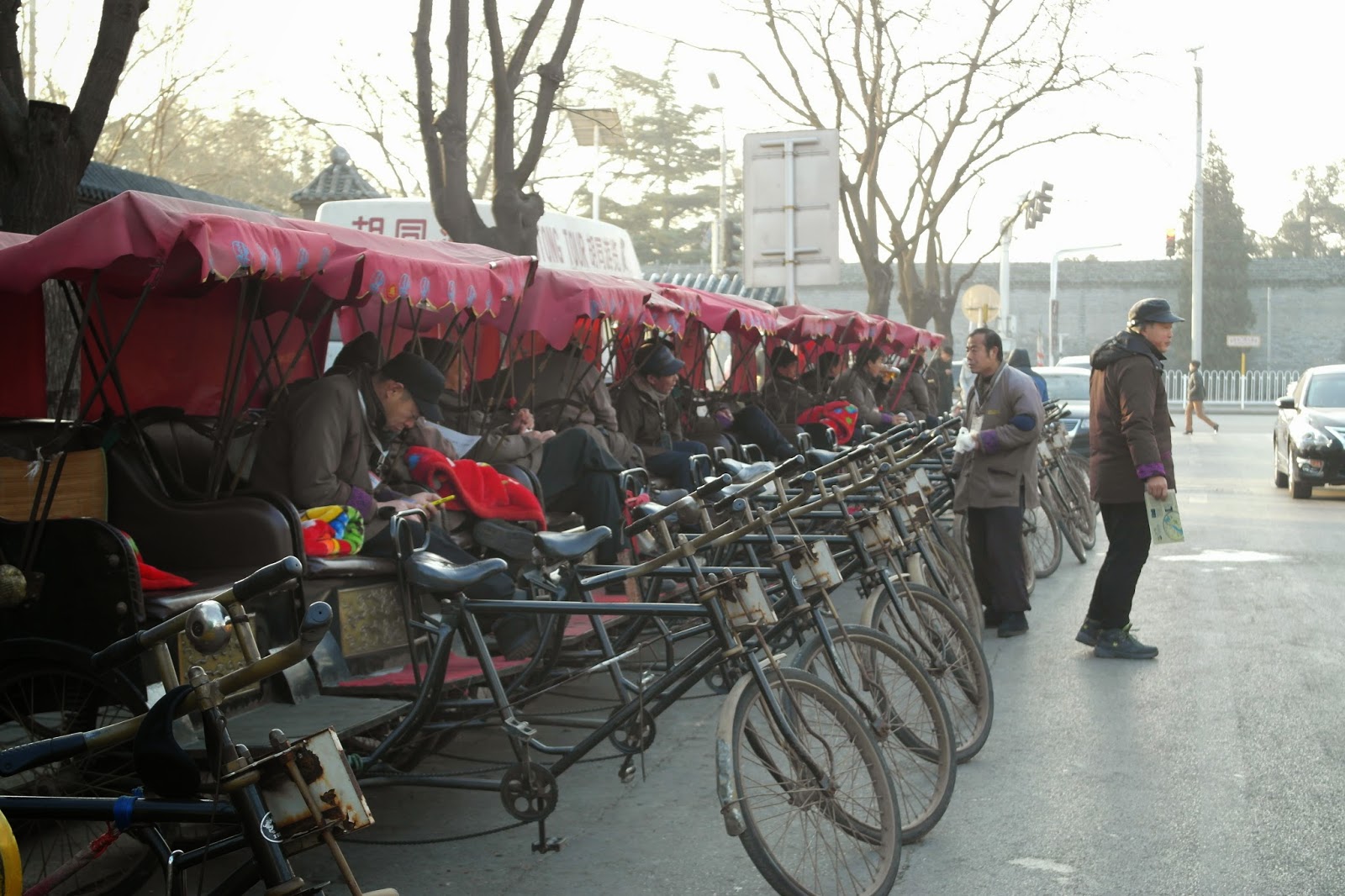
Trishaw services is available to drive visitors around. 


2) Qianmen Street 前门街


Located in between Tiananmen Square and Temple of Heaven is the oldest and most famous ancient pedestrian shopping street: Qianmen street 前门街.


It has undergone a year of renovation and just reopened before 2008 Beijing Olympics. Although it has many international brand store, there are still many preserved ancient Beijing buildings.

It has been a prosperous area for more than 600 years and has accumulated some long-standing stores like Tong Ren Tang.

Dang dang tram

It has the snowy look right! It gave a very christmasy feeling! WHY DIDNT IT SNOW??

Having matcha ice cream at near 0 degree weather was indescribable.


3) Wang Fu Jing 王府井


Basically this is just like our Orchard Road with all the big international brands.

So pretty at night.

This was the only time we felt so relaxed walking around without time constraint as tour guide gave us all the time to shop, have dinner ourselves and take cab back to hotel as it is very close by. 


I have craving for steamboat because winter is the best time to eat steamboat! So, we went back to our hotel as our tour guide told us there is a famous eating street just a street away from our hotel.


 We over ordered partly because we were too hungry and the waitress didn't warn us about the super big plate of beef. It was too reasonably priced (only around S$10) that we did not think of the size at all. 

4) Wangfujing snack street


This is the street that you must not missed when you are in Wangfujing. 

Wangfujing Snack Street is conveniently located just adjacent to Wangfujing Street. However it is over commercialized and touristy, the prices are not as low as other places. Tons of snacks from all corners of China can be found there.


Even insects...


Just next to Wangfujing snack street is Laobeijing snack street. They pretty much sell the same kind of food. 


They looked so yummy and sinful lol..

4) Beijing National Stadium (Bird's Nest 鸟巢)


Beijing National Stadium was the main venue of the 2008 Beijing Olympic Games.


Tour guide was right. It looks better at night when it lights up.


Sabtu, 06 Juni 2015

Gunung Sari Market (wet and dry) at Lombok island - Indonesia

On the third day morning, before we travel to Sendang Gile Waterfall at the Mount Rinjani, we stopped by the local market - Gunung Sari Market - wet and dry  (S8.54177 E116.10707).

As Pak Uji said, they called this type of market '7-11'. But it's not similar to the convenience stall we familiar with, 7-11 is the operating or business hour of the market...means 7-11am.

Before we step into the market, there was a row horse-drawn carriage called 'Cidomo', use as a short distance public transport for the locals.

 photo IMG_3390_zpsjadh9z67.jpg
Cidomo - a small horse-drawn carriage as local transport

We walked through the dry market and there were many stuffs that really new to me. From the daily necessity, cloths, snacks and foods.

 photo IMG_3396_zpszvfnq3n9.jpg

 photo IMG_3397_zps54femxqn.jpg

 photo IMG_3401_zpsarcv6xmo.jpg

 photo IMG_3403_zpserawb5xu.jpg

 photo IMG_3404_zps4osmagus.jpg

 photo IMG_3407_zps3qykr155.jpg

I noticed some of the foods (for breakfast) were really look delicious! Too bad, we already had our breakfast in resort...or else I will definitely try some of it...

 photo IMG_3402_zps9yqrui3k.jpg
Unique foods in the market

 photo IMG_3409_zpsoubju8mg.jpg

After about an hour, we came to the end of the dry market...unfortunately the time was not allow for us to continue to the wet session.

Another type of public transport spotted at the exit, it looks like 'Angkot' from Jakarta but with a smaller capacity...too bad I forgot to get the name of it...

 photo IMG_3412_zps98bni9qg.jpg
Public transport of Lombok island

 photo IMG_3411_zpsk7ki36pm.jpg

The familiar scene in Bali island also happen here in Lombok, the gasoline for light vehicles was easy available along the busy street of Lombok island.

 photo IMG_3414_zpsdiiudhwj.jpg
Gasoline widely available along the street

While waiting for our teammate - Tony who was missing in the market, we took another group photo before our next destination - Sendang Gile Waterfall.

 photo IMG_3410_zpskohkdtbl.jpg
Group photo of our teammate in Lombok island

Related post for Lombok island trip :-
Airasia media FAM trip to Lombok Island - Indonesia on July 2014

Location map of Gunung Sari Market in Lombok island


Selasa, 02 Juni 2015

China - Day trip to Tianjin

Tianjin - Dec 2014


We took a day trip to Tianjin. To be honest, I do not have not much impression of Tianjin before the trip and now after the trip, I would have prefer Xi An instead. 

The tour guide took us to the biggest food mall in China that was selected as one of the “Top ten Tianjin attractions” in 1989 - Tianjin Nanshi Food Mall.


Basically, we were given 30-45 minutes to explore the three storey food mall which over 100 food shops and restaurants offering local delicacies. We were also told to buy from a few particular shops which were deemed more trustworthy. I chose to believe that tour guide is in collaboration with the mentioned shops.  

One of the unique snacks in Tianjin - Fried dough twist 麻花. It is sweet-smelling and crispy. Do you know this snack cannot go bad even after being stored for several months. 


The shifu was very skillful to draw a tank for this little boy.

Ear hole fried rice cake 耳朵眼炸糕

wheat meat 面筋. It looks very weird...

Honey soft cake 蜂密软糖


Next, we headed to Tianjin Ancient Culture Street 古文化街.

The street is famous for calligraphy and painting brushes of Four Treasures, cultural antiques, double-sided embroidery, jade carvings and art ceramics. It is the street where you can get all the chinese pottery souvenirs.


Terribly underdressed for a cold weather.


We were rushing for train back to Beijing so we literary walked past the 5th avenue and Italian town in very fast pace. I am the sort of people who like to stop, take pictures and enjoy the scenery. Oh well, this is the price you have to pay if you join a tour.


It is ironic that when I googled about Tianjin, it came out "With its cool sea breeze and fresh sea air you will definitely feel refreshed". But I can only remember haze, haze and haze.


Jumat, 08 Mei 2015

I consider Dark Tourism, in a comparative persective


Tourists visit slave cabins at Boone Hall plantation, near Charleston

Visitors walk past barracks at Auschwitz, which house exhibits


By Ruth Ellen Gruber

I've been in Charleston, SC, for the past four months, teaching this semester as the Distinguished Visiting Chair in Jewish Studies at the College of Charleston.

During my stay, I've begun to consider parallels -- and dissonances -- between the way Jewish heritage and history, including the Holocaust, are presented in Eastern Europe and the way African American (including slave) history and heritage are presented in the Charleston area.

Here's a brief essay I wrote, for the web site of the Drayton Hall plantation, exploring some of the issues.

- - - -
More than 20 years ago I wrote a book called Upon the Doorposts of Thy House: Jewish Life in East-Central Europe, Yesterday and Today. The title referred to the mezuzah—the encased prayer scroll Jews place on their doorposts, indicating a house as the home of a Jew.

In post-Holocaust Europe you could often find the grooves or scars where mezuzahs had been removed or painted over during or after the Shoah—thus forming symbolic mezuzahs that indicated a house where Jews once lived. In my book, I extrapolated further, suggesting that the surviving physical relics of pre-war Jewish life—synagogue buildings, Jewish cemeteries, even if abandoned, in ruined condition or transformed for other use, also served as symbolic mezuzahs to mark towns, villages, cities, and even countries where Jews once lived and do not live now.

My intent was to show how buildings and other physical sites can be talismans and touchstones, opening the way into memory and history.

George McDaniel made this same idea explicit in his introduction to the panel of Drayton Hall descendants. “History did not happen to someone, somewhere else, but to you,” he said. “You grow up a product of history. Preserving buildings means also preserving the story behind the buildings, making a connection with people. Why is a place important? How do you feel connected?”

From the Jewish perspective, visiting Jewish historical sites in post-Holocaust, post-Communist Europe can be a very positive experience, emphasizing Jewish life, history and culture; but the experience also falls under what is now known as Dark Tourism—tourism to sites of what we can call “negative” history, “negative” experience: death, destruction, war.

Sites of slavery also fall under Dark Tourism, though this aspect of a historic site (such as a plantation or genteel antebellum home) often becomes masked, elided, or simply footnoted in the presentation of beautiful buildings and gardens for tourist consumption.

Much of this boils down to “who controls the narrative”—and to whom is the narrative directed: issues that we have been dealing with in the class I have been teaching, “Memory, Heritage, Renewal.” Although the main focus of our class is Jewish heritage and memory and their role and representation in Europe, we have been able to draw parallels with the way that African American heritage, history, and culture are presented here in Charleston and the Lowcountry.

I was delighted that students from my class were in attendance at the panel presentation featuring the descendants of Drayton Hall, as the discussion clearly demonstrated the parallels we have been dealing with, touching on issues such as the point of view of interpretation and interpreters; messages and signage; how the same place can have different symbolic meanings and generate different memories for different people.

I found particularly compelling a part of the film about Drayton Hall’s African American descendants that parallels the post-Holocaust Jewish experience in Europe. People were filmed sitting in the African American cemetery at Drayton Hall, speaking about how many of the deceased buried there had no markers for their graves, no one to talk about their history. In Eastern Europe, when I visit an abandoned Jewish cemetery, I often ponder the fact that most of the thousands and thousands of people buried in these places are also forgotten, with no descendants to tend their graves or even remember who they were.

Drayton is not alone in trying to present a more inclusive past in the plantation context. Boone Hall has installed an extensive presentation on slavery and African American history centered on the nine preserved slave cabins there. Magnolia Gardens features special programs to bring to life its recently renovated row of cabins. And Middleton Place, which I have not yet visited, presents a permanent exhibit titled “Beyond the Fields” in a two-family tenant residence called Eliza’s House, in memory of Eliza Leach, a South Carolina African American born in 1891, and the last person to live in the building. The much less elaborate Hampton Plantation also incorporates the site’s slave history in well researched text panels, both in the Big House and along the path leading to it.

After the Drayton Hall panel, I was excited to visit McLeod Plantation with Mary Battle, public historian at the Avery Research Center for African American History and Culture, and her class. McLeod, which served as local headquarters of the Freedman’s Bureau following the Civil War, has the potential to interpret not only slave life but the postwar experience of the newly freed men and women. McLeod’s signage uses a phrase that could be the site’s “slogan”—describing it as a place of both “tragedy and transcendence.” I found it interesting that this formulation echoes what we sometimes call sites of Jewish heritage in Europe—“sites of tragedy and sites of triumph.”
Read article on the web site